
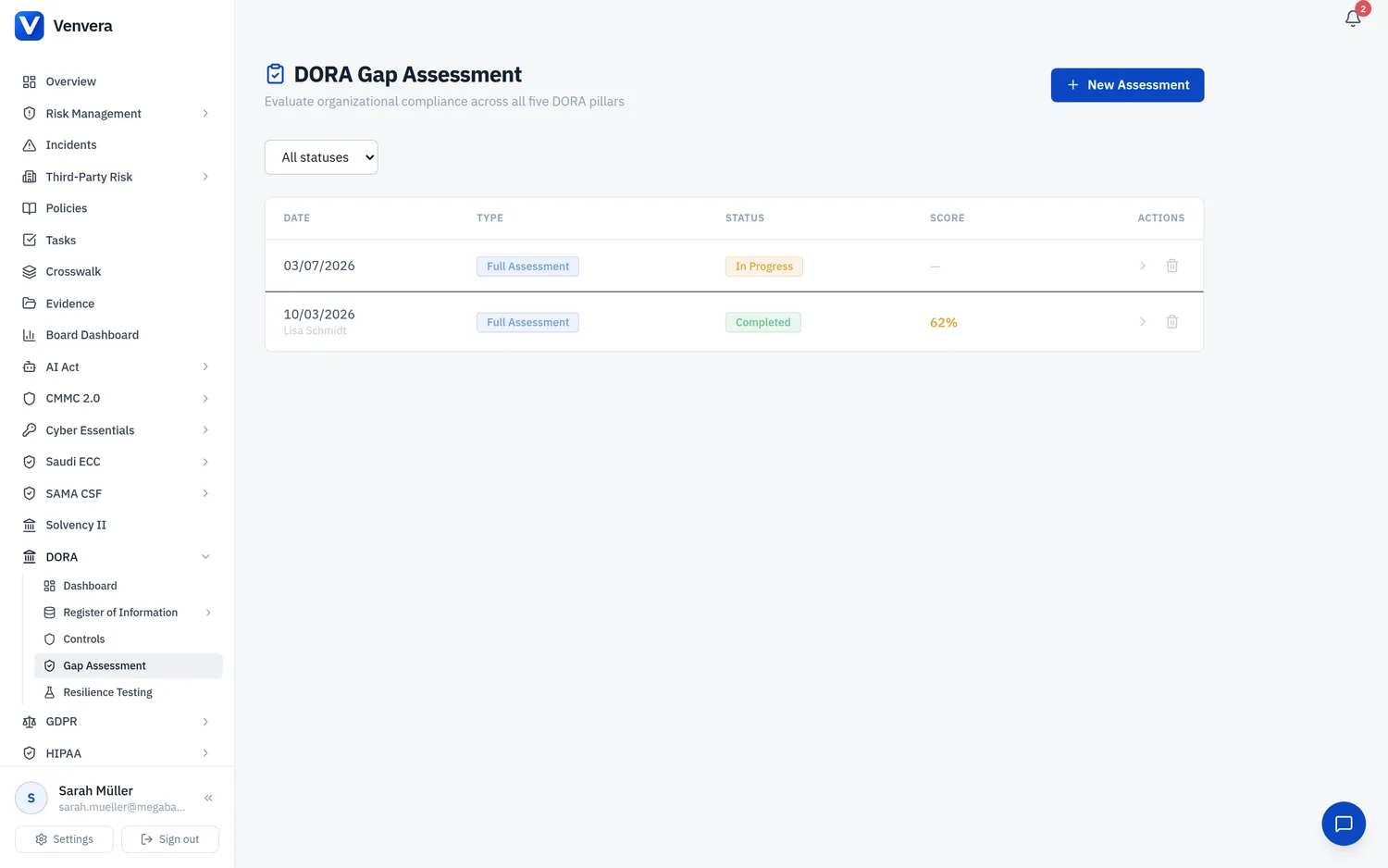
The ISO 27001 Gap Assessment evaluates your Information Security Management System against the requirements of ISO/IEC 27001:2022. The assessment covers the mandatory clauses (4 through 10) that define the ISMS management system requirements, as well as the applicable Annex A controls identified in your Statement of Applicability.
Assessment Structure
The gap assessment is organised into two parts:
Part 1: ISMS Clauses (4-10)
These clauses define the "shall" requirements for the management system itself. Every clause must be addressed regardless of your ISMS scope:
| Clause | Title | Key Areas Assessed |
|---|---|---|
| Clause 4 | Context of the Organisation | Understanding the organisation and its context, needs and expectations of interested parties, scope of the ISMS, ISMS and its processes |
| Clause 5 | Leadership | Leadership and commitment, information security policy, organisational roles responsibilities and authorities |
| Clause 6 | Planning | Actions to address risks and opportunities, information security objectives and planning, planning of changes |
| Clause 7 | Support | Resources, competence, awareness, communication, documented information (creation, updating, control) |
| Clause 8 | Operation | Operational planning and control, information security risk assessment, information security risk treatment |
| Clause 9 | Performance Evaluation | Monitoring measurement analysis and evaluation, internal audit, management review |
| Clause 10 | Improvement | Continual improvement, nonconformity and corrective action |
Part 2: Annex A Controls
The gap assessment for Annex A controls is linked to your Statement of Applicability. Only controls marked as "Applicable" in the SoA are included in the gap assessment. This ensures you are only assessed against controls relevant to your ISMS scope.
Maturity Scoring
Each assessment question is scored on the same 0-4 maturity scale used across all Venvera gap assessments:
| Score | Level | Description |
|---|---|---|
| 0 | Not Implemented | No evidence of the requirement being addressed. No policies, procedures, or controls exist. |
| 1 | Initial | Ad-hoc or reactive approach. Some awareness exists but practices are informal, undocumented, and inconsistent. |
| 2 | Developing | Basic processes are being established. Some documentation exists. Practices are applied in some areas but not consistently organisation-wide. |
| 3 | Defined | Formal, documented processes are established and consistently applied. Policies are approved, communicated, and reviewed. Evidence is maintained. |
| 4 | Optimised | Mature, continuously improving processes driven by metrics. Regular testing, review, and enhancement. Proactive approach with industry best practices adopted. |
Results
The results page displays your assessment findings in several views:
Clause Scores
A bar chart shows the maturity score for each clause (4 through 10). This highlights which management system areas are strongest and which need the most work. Each bar is colour-coded by maturity level.
Overall Percentage
Your overall ISO 27001 compliance percentage is calculated by combining clause scores and Annex A control scores. The formula converts the average maturity score (0-4 scale) to a percentage (0-100%).
Annex A Category Scores
Scores for the four Annex A categories (A.5 Organisational, A.6 People, A.7 Physical, A.8 Technological) are shown separately, allowing you to identify which control domains need improvement.
Remediation Plan Generation
The system automatically generates a remediation plan based on your assessment results:
- Critical items (score 0) - flagged for immediate action with suggested 30-day target
- High priority items (score 1) - 60-day target
- Medium priority items (score 2) - 90-day target
- Items scored 3 or 4 are not included in the remediation plan
Each remediation item includes the clause or control reference, current score, target score, recommended actions, and an assignable owner field.
Comparison with SoA
The gap assessment results page includes a comparison view with your Statement of Applicability. This cross-reference identifies inconsistencies:
- Controls marked as "Full" implementation in the SoA but scored below 3 in the gap assessment
- Controls marked as "Not Started" in the SoA but scored above 0 in the gap assessment
- Controls not yet assessed in either the SoA or gap assessment
Resolving these inconsistencies ensures your SoA and gap assessment are aligned and present a coherent picture to auditors.