
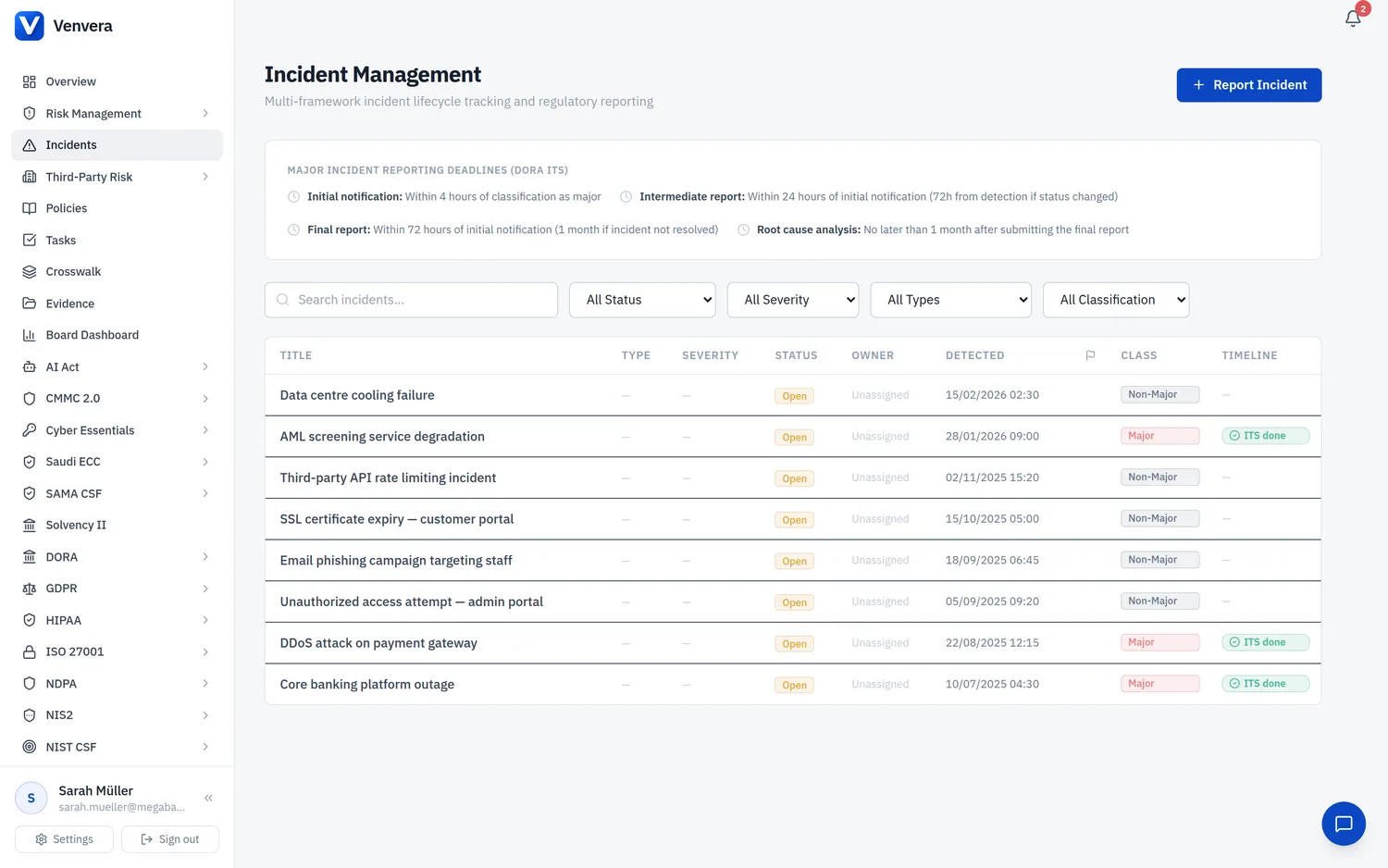
The Incident Readiness module helps your organisation prepare for the strict incident notification requirements under NIS2 Article 23. Rather than tracking live incidents (which is handled by the shared Incidents module), this module focuses on ensuring your organisation is ready to detect, classify, and report significant incidents within the mandated timeframes.
Article 23 Notification Requirements
NIS2 imposes a tiered notification regime for significant incidents. Your organisation must notify the relevant CSIRT or competent authority within the following deadlines:
Notification Timeline
| Deadline | Notification Type | Content Requirements |
|---|---|---|
| 24 hours | Early Warning | Without undue delay and within 24 hours of becoming aware of the significant incident. Must indicate: (a) whether the incident is suspected of being caused by unlawful or malicious acts, and (b) whether it could have a cross-border impact. |
| 72 hours | Incident Notification | Without undue delay and within 72 hours of becoming aware. Must update the early warning and provide: (a) an initial assessment of the incident including its severity and impact, and (b) indicators of compromise where applicable. |
| 1 month | Final Report | No later than one month after the incident notification submission. Must include: (a) detailed description of the incident including severity and impact, (b) the type of threat or root cause that likely triggered the incident, (c) applied and ongoing mitigation measures, and (d) where applicable, the cross-border impact. |
What Constitutes a "Significant Incident"
An incident is considered significant if it:
- Has caused or is capable of causing severe operational disruption of the services or financial loss for the entity
- Has affected or is capable of affecting other natural or legal persons by causing considerable material or non-material damage
Incident Readiness Checklist
The module provides an interactive readiness checklist to ensure your organisation has all necessary preparations in place. Each item can be marked as Complete, In Progress, or Not Started:
| Checklist Category | Items |
|---|---|
| Governance |
|
| Detection |
|
| Classification |
|
| Notification |
|
| Response |
|
| Testing |
|
Notification Templates
Venvera provides pre-built notification templates aligned with the content requirements specified in Art. 23. These templates can be customised for your organisation:
Early Warning Template (24 hours)
The early warning template captures the minimum information required:
- Reporting entity details (name, NIS2 registration, sector)
- Date and time the incident was detected
- Preliminary description of the incident
- Whether unlawful or malicious action is suspected (Yes / No / Unknown)
- Potential cross-border impact (Yes / No / Unknown)
- Contact person for follow-up
Incident Notification Template (72 hours)
The incident notification template expands on the early warning with:
- Reference to the prior early warning
- Updated description with additional details
- Initial severity and impact assessment
- Affected services and estimated number of affected users
- Indicators of compromise (IoCs) if available
- Mitigation measures taken so far
Final Report Template (30 days)
The final report template covers the full analysis:
- Comprehensive incident description and timeline
- Root cause analysis and threat type classification
- Total impact assessment (operational, financial, reputational)
- All mitigation and remediation measures applied
- Cross-border impact details (if applicable)
- Lessons learned and preventive measures implemented
Authority Contact Information
The module includes a section to manage contact details for relevant authorities. You can record:
| Field | Description |
|---|---|
| Authority Name | Name of the national CSIRT or competent authority |
| Country | EU Member State |
| Primary Contact Email | Official notification email address |
| Primary Contact Phone | Emergency or out-of-hours contact number |
| Notification Portal URL | Link to the online notification portal (if applicable) |
| Alternative Contact | Backup contact details |
| Notes | Specific instructions, reference numbers, or other details |
Cross-Reference with Incidents Module
The Incident Readiness module focuses on preparation. When an actual incident occurs, use the shared Incidents module (accessible from the main sidebar) to log, track, and manage the incident lifecycle. The Incidents module provides:
- Incident creation and classification
- Timeline tracking and status updates
- NIS2 notification deadline tracking with countdown timers
- Document attachments for evidence and reports
- Post-incident review workflows
Readiness Assessment Scoring
Your overall incident readiness score is calculated based on the checklist completion status:
- Complete items contribute full points toward the category score
- In Progress items contribute half points
- Not Started items contribute zero points
The overall readiness score is displayed as a percentage and feeds into the NIS2 dashboard compliance ring chart. Aim for a readiness score of at least 80% before considering your organisation prepared for NIS2 incident obligations.