
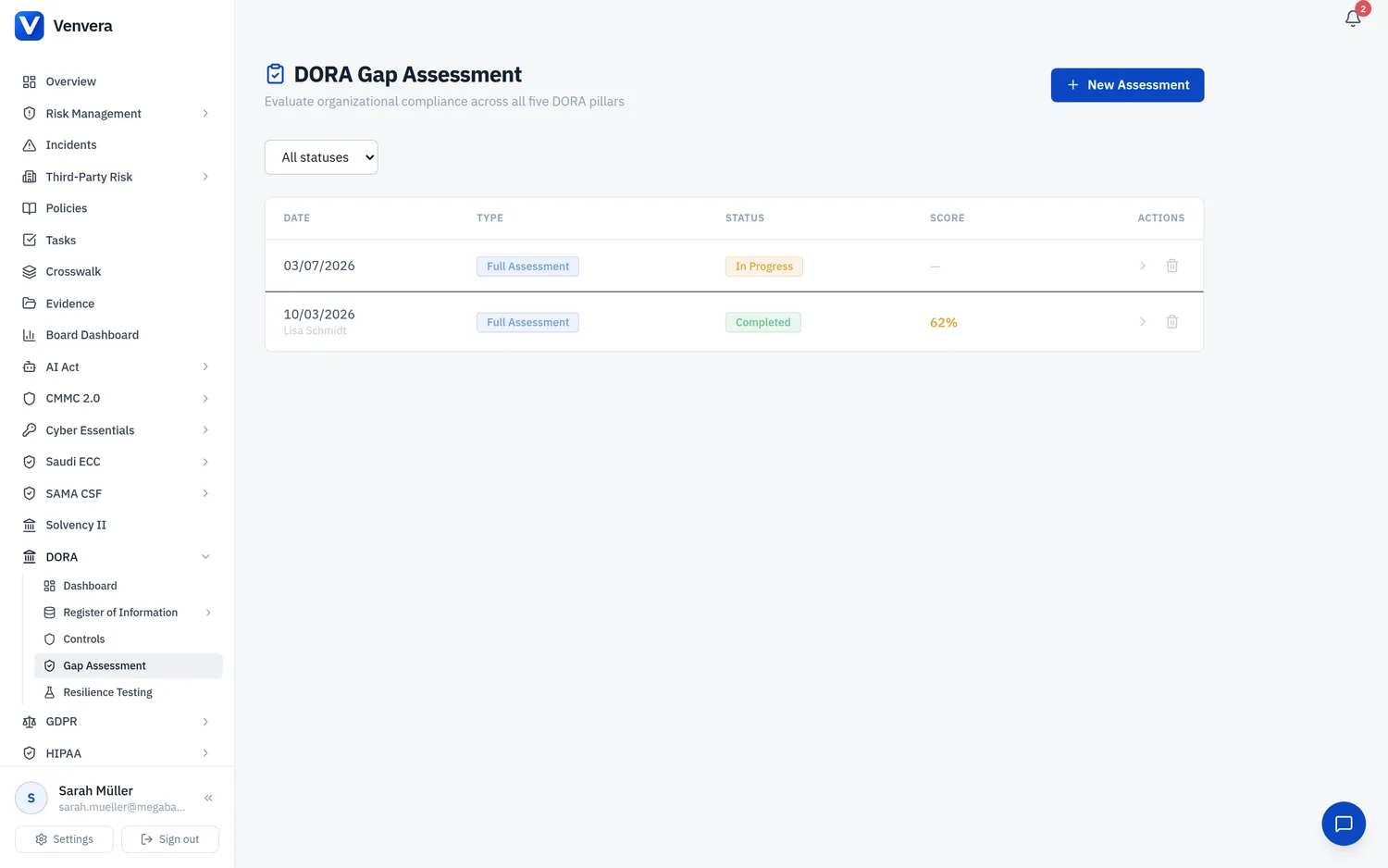
The NIS2 Gap Assessment evaluates your organisation's cybersecurity maturity against the ten security measure categories defined in Article 21(2) of the NIS2 Directive. Each category is represented as an assessment pillar containing targeted questions that measure your implementation maturity on a 0-4 scale.
The 10 Assessment Pillars
Each pillar maps directly to a requirement in Article 21(2)(a) through (j). The assessment covers every aspect that national competent authorities may evaluate during supervision.
Pillar 1: Risk Analysis and Information System Security Policies - Art. 21(2)(a)
This pillar assesses whether your organisation has established and maintains comprehensive risk analysis processes and information system security policies. Questions cover:
- Formal risk assessment methodology documented and approved by management
- Regular risk assessments performed (at least annually or upon significant change)
- Risk treatment plans with assigned owners and deadlines
- Information security policy approved by management body
- Policy review cycle and version control
- Risk appetite and acceptance criteria formally defined
- Asset inventory and classification scheme
Pillar 2: Incident Handling - Art. 21(2)(b)
Evaluates your incident detection, response, and reporting capabilities:
- Incident response plan documented and tested
- Detection capabilities (SIEM, IDS/IPS, EDR, log monitoring)
- Incident classification and severity matrix
- Escalation procedures and communication plans
- Post-incident review and lessons-learned process
- NIS2 notification procedures (24h/72h/30-day compliance)
- Evidence preservation and forensic readiness
Pillar 3: Business Continuity and Crisis Management - Art. 21(2)(c)
Assesses resilience planning and crisis management capabilities:
- Business impact analysis (BIA) performed and current
- Business continuity plans for critical functions
- Disaster recovery plans with defined RTOs and RPOs
- Backup strategy and regular restoration testing
- Crisis management team and communication protocols
- Regular BCP/DRP testing (tabletop and live exercises)
- Alternative processing arrangements
Pillar 4: Supply Chain Security - Art. 21(2)(d)
Reviews how your organisation manages security risks in the supply chain:
- Supplier security assessment process
- Contractual security requirements for suppliers
- Ongoing monitoring of supplier security posture
- Critical supplier identification and dependency mapping
- Incident notification clauses in supplier contracts
- Supply chain risk assessment and mitigation
- Supplier access management and segmentation
Pillar 5: Network and Information Systems Security - Art. 21(2)(e)
Evaluates technical security of network and information systems:
- Network segmentation and architecture security
- Vulnerability management and patching process
- Secure configuration baselines (hardening)
- Security monitoring and logging
- Acquisition, development, and maintenance security
- Vulnerability disclosure and handling procedures
- Penetration testing programme
Pillar 6: Policies and Procedures for Assessing Effectiveness - Art. 21(2)(f)
Assesses how your organisation measures and evaluates its security programme:
- Security KPIs and metrics programme
- Regular security assessments and audits
- Management review of security effectiveness
- Compliance monitoring processes
- Continuous improvement framework
- Benchmarking against industry standards
Pillar 7: Basic Cyber Hygiene and Training - Art. 21(2)(g)
Reviews fundamental cybersecurity practices and awareness programmes:
- Security awareness training programme for all staff
- Management body cybersecurity training (Art. 20 requirement)
- Phishing simulation and testing
- Acceptable use policies
- Password/authentication policies
- Removable media controls
- Clean desk and clear screen policies
Pillar 8: Cryptography and Encryption - Art. 21(2)(h)
Evaluates the use of cryptographic controls:
- Cryptography policy and approved algorithms
- Encryption of data at rest and in transit
- Key management procedures (generation, storage, rotation, destruction)
- Certificate management
- End-to-end encryption for sensitive communications
- Crypto agility and migration readiness
Pillar 9: Human Resources Security and Access Control - Art. 21(2)(i)
Assesses people-related security controls and access management:
- Pre-employment screening and vetting
- Security responsibilities in job descriptions
- Joiner/mover/leaver processes
- Access control policy (need-to-know, least privilege)
- Privileged access management
- Regular access reviews and recertification
- Identity and access management (IAM) system
Pillar 10: Multi-Factor Authentication and Continuous Monitoring - Art. 21(2)(j)
Reviews advanced authentication and monitoring capabilities:
- MFA deployed for all remote access and privileged accounts
- MFA for critical application access
- Continuous authentication mechanisms
- Secured voice, video, and text communications
- Secured emergency communication systems
- Real-time security monitoring and alerting
- Security operations centre (SOC) or equivalent capability
Maturity Scoring Scale
Each question in the assessment is scored on the following 0-4 maturity scale:
| Score | Level | Description |
|---|---|---|
| 0 | Not Implemented | No controls, processes, or documentation exist for this area. The organisation has not addressed this requirement. |
| 1 | Initial | Ad-hoc or reactive measures exist. Some awareness of the requirement but no formal processes. Efforts are inconsistent and undocumented. |
| 2 | Developing | Basic processes are being established. Some documentation exists but practices are not yet consistently applied across the organisation. |
| 3 | Defined | Formal, documented processes are in place and consistently followed. Policies are approved and communicated. Regular reviews occur. |
| 4 | Optimised | Mature, continuously improving processes. Metrics-driven management. Regular testing, review, and enhancement. Industry best practices adopted. |
How to Complete the Assessment
Navigate to the Gap Assessment page from the NIS2 module. Use the pillar navigation panel on the left to select the pillar you want to assess. Pillars are labelled (a) through (j) matching the Article 21(2) references. A progress indicator shows completion status for each pillar.
For each question within the selected pillar, select a maturity score from 0 to 4 using the radio buttons or score selector. Read the question carefully and consider the full description of each maturity level before selecting your score.
For each question, you can optionally add notes or evidence references to support your chosen score. This is strongly recommended for scores of 3 or 4, as you may need to demonstrate these claims during an audit or supervisory review.
Your responses are automatically saved as you progress through the assessment. You do not need to click a save button. You can leave and return to the assessment at any time without losing progress.
Use the pillar navigation panel to move between pillars. Complete all 10 pillars for a full assessment. The navigation shows which pillars are complete, in progress, or not started.
Once all pillars are complete, navigate to the Results page to see your overall compliance score and detailed breakdown.
Scoring Formula
The overall NIS2 compliance score is calculated using a weighted average:
- Each pillar's score is the average of all question scores within that pillar (0-4 scale)
- Pillar scores are converted to percentages: (pillar average / 4) x 100
- The overall score is the weighted average of all pillar percentages
- By default, all pillars are equally weighted (10% each)
Results Page
The results page provides a comprehensive view of your assessment outcome:
Overall Score Ring
A large ring chart displays your aggregate NIS2 compliance score. The ring is colour-coded using the same thresholds as the dashboard (red/orange/yellow/green).
Pillar Score Bars
Horizontal bar charts show the score for each of the 10 pillars, allowing quick visual comparison. Bars are colour-coded by maturity level. Hover over a bar to see the exact score and question count.
Detailed Breakdown
Expand any pillar to see individual question scores, your notes, and evidence references. This view helps identify specific areas needing improvement.
Remediation Roadmap
The system automatically generates a remediation roadmap for any questions or pillars scoring below 3 (Defined). The roadmap includes:
- Priority ranking - items scored 0 (Not Implemented) are flagged as critical priority, followed by scores of 1 (high) and 2 (medium)
- Recommended actions - specific steps to improve maturity for each low-scoring area
- Target dates - suggested timelines based on priority level
- Responsible party - assign an owner for each remediation action
- Status tracking - mark items as Not Started, In Progress, or Complete