
PCI-DSS places significant emphasis on proactive vulnerability management and regular security testing. Requirements 5, 6, and 11 collectively address anti-malware protection, secure development, vulnerability scanning, and penetration testing.
Requirement 5: Anti-Malware
All systems commonly affected by malicious software must have anti-malware solutions that:
- Detect and remove all known types of malicious software
- Perform periodic scans and real-time (on-access) scanning
- Generate audit logs and retain them per Requirement 10.7
- Cannot be disabled or altered by users (unless specifically documented and authorised on a case-by-case basis with time-limited approvals)
- Include anti-phishing mechanisms to detect and protect against phishing attacks (new in v4.0.1)
Requirement 6: Secure Development
Organisations must develop and maintain secure systems and software:
- Patch management - Install critical security patches within one month of release; high and medium patches within an appropriate timeframe based on risk ranking
- Secure development lifecycle - Develop software based on industry standards and/or best practices, incorporating security throughout the SDLC
- Code review - Public-facing web applications must be protected by either manual/automated code review before release or by deploying a web application firewall (WAF)
- Change control - All changes to system components must follow a change management process with impact analysis, approval, testing, and rollback procedures
- Training - Development personnel must receive training on secure coding at least annually, covering common vulnerabilities (OWASP Top 10, CWE Top 25)
Requirement 11: Security Testing
Regular testing ensures that security controls remain effective:
Quarterly ASV Scans (Requirement 11.3.2)
External vulnerability scans must be performed quarterly by an Approved Scanning Vendor (ASV):
- Scans must cover all externally accessible (internet-facing) IP addresses and domains
- A passing scan has no vulnerabilities scored 4.0 or higher on CVSS
- Failing scans must be remediated and re-scanned until a passing result is achieved
- Four quarterly passing scans within 12 months are required for initial compliance
Internal Vulnerability Scanning (Requirement 11.3.1)
Internal vulnerability scans must be performed:
- At least quarterly and after any significant change to the environment
- All high-risk and critical vulnerabilities (per the entity's vulnerability risk rankings) must be resolved
- Rescans must be performed to verify remediation
Penetration Testing (Requirement 11.4)
Penetration testing must be performed:
- Annually for merchants; every six months for service providers
- Test from both inside and outside the network
- Test both the network layer and the application layer
- Include segmentation testing to validate that out-of-scope systems are isolated
- After any significant infrastructure or application changes
- By a qualified internal resource or external third party (must be organisationally independent)
Application Security Testing (Requirement 6.2)
Custom and custom-code applications must be reviewed for vulnerabilities:
- Manual or automated application vulnerability security assessment tools or methods
- Testing before release and after significant changes
- Coverage of OWASP Top 10 and CWE Top 25 vulnerabilities
Tracking Assessments in Venvera
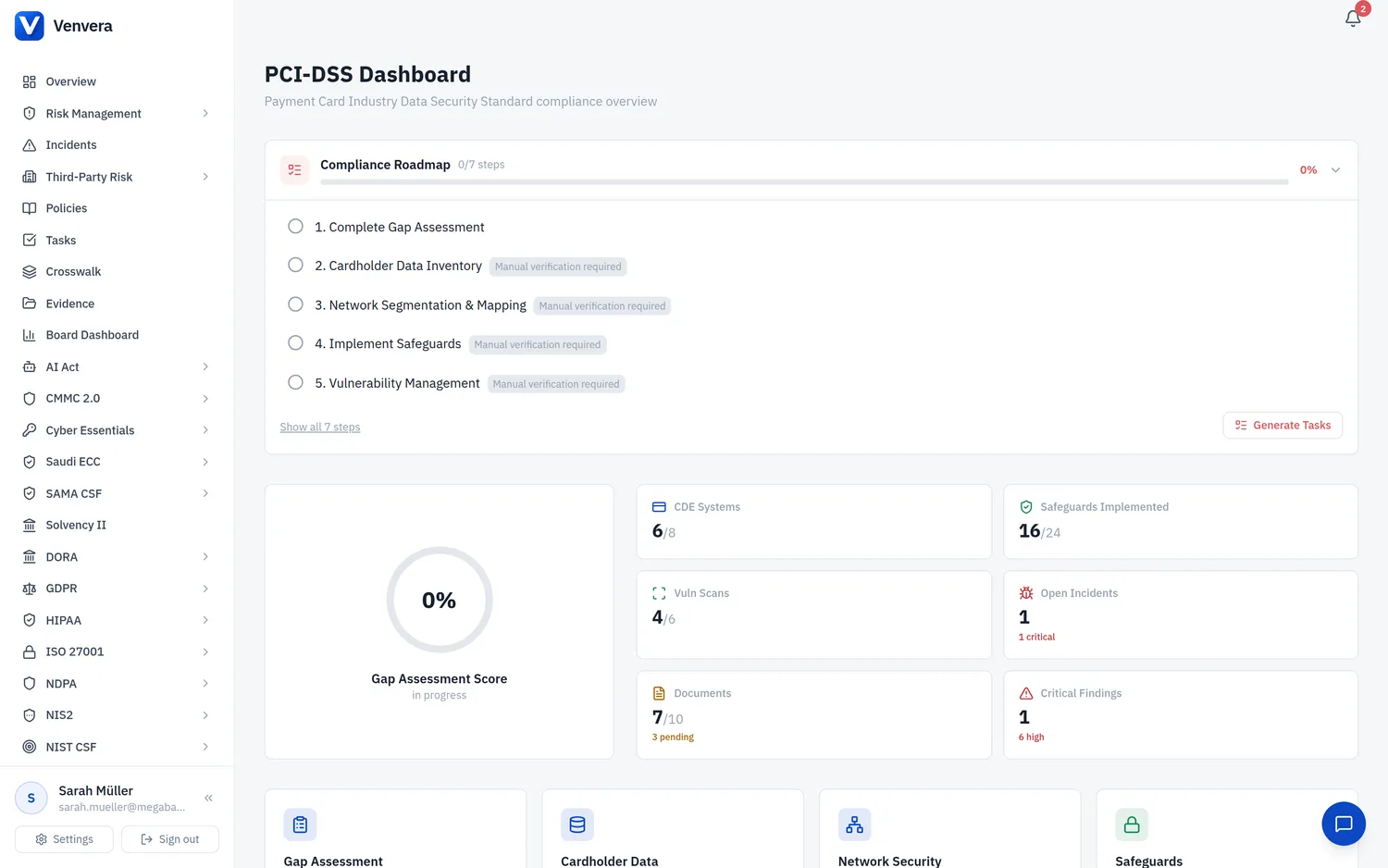
The Vulnerability Management module tracks all security assessments with the following information:
- Assessment type - Vulnerability scan, penetration test, ASV scan, application scan, or segmentation test
- Provider - The ASV, pen test firm, or internal team performing the assessment
- Scan/test dates - When the assessment was performed and when the next one is due
- Pass/fail status - Whether the assessment result meets PCI-DSS requirements
- Findings breakdown - Critical, high, medium, and low findings counts
- Remediation deadline - Target date for resolving identified vulnerabilities