
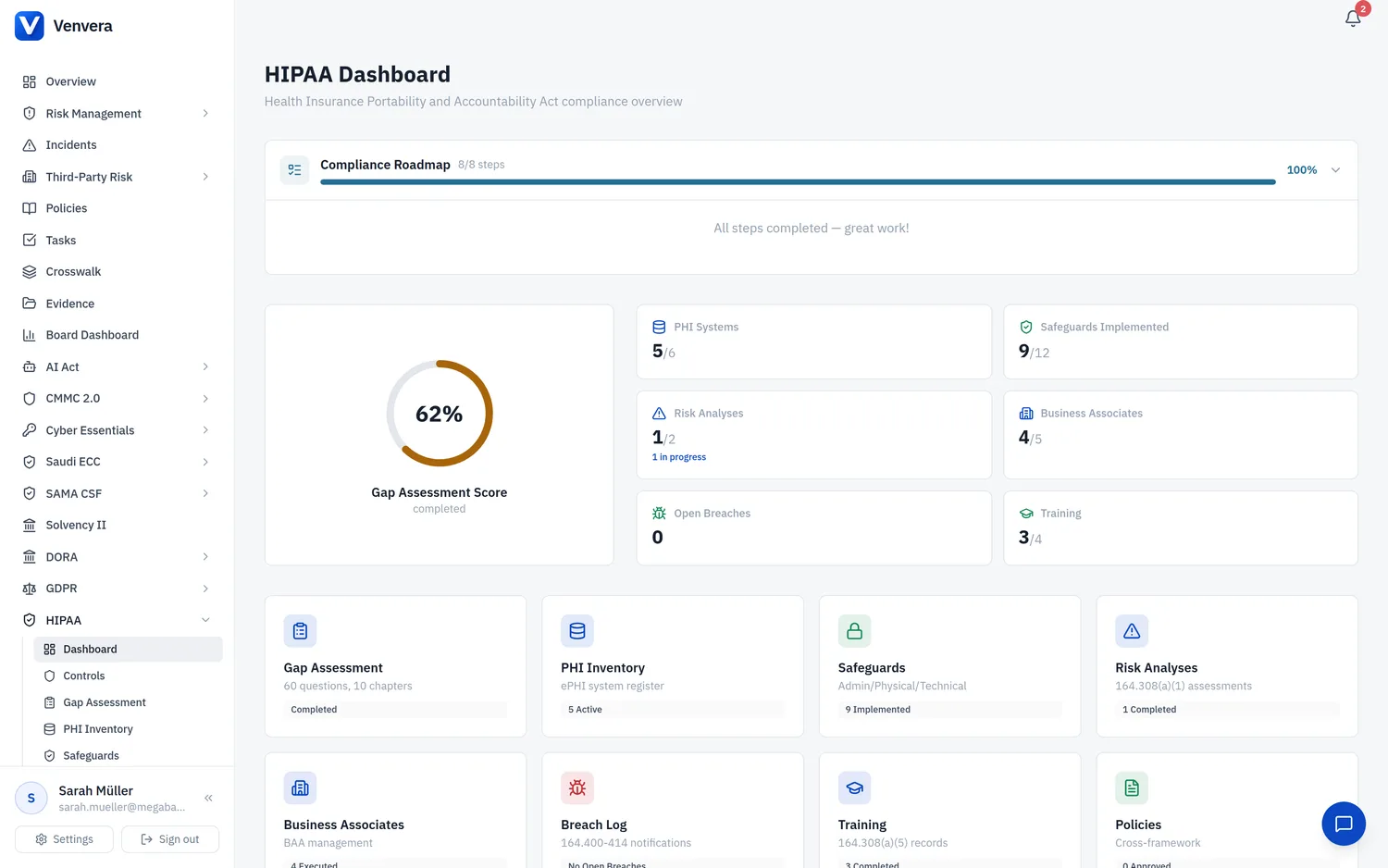
The Health Insurance Portability and Accountability Act (HIPAA) is a United States federal law enacted in 1996 that sets national standards for the protection of individually identifiable health information. HIPAA is enforced by the Office for Civil Rights (OCR) within the U.S. Department of Health and Human Services (HHS).
Venvera's HIPAA module covers the full compliance lifecycle:
- PHI Inventory - Track all systems, applications, and repositories containing protected health information
- Safeguards Management - Manage Administrative, Physical, and Technical safeguards per the Security Rule
- Risk Analysis - Conduct and document Security Rule risk analyses per 45 CFR 164.308(a)(1)
- Business Associate Management - Track BAAs, subcontractors, and downstream obligations
- Breach Notification - Manage breach reporting to individuals, HHS, and media per notification timelines
- Gap Assessment - Evaluate compliance maturity across Privacy Rule, Security Rule, and Breach Notification Rule
- Training Records - Track workforce HIPAA training completion and due dates
- Policies & Procedures - Maintain HIPAA-required policies with 6-year retention tracking
Who Does HIPAA Apply To?
HIPAA applies to two categories of organisations:
| Covered Entities | Health plans, health care clearinghouses, and health care providers who transmit health information electronically in connection with covered transactions |
| Business Associates | Persons or organisations that perform functions or activities on behalf of, or provide certain services to, a covered entity that involve access to protected health information (PHI) |
Key HIPAA Rules
| Privacy Rule | 45 CFR Part 160 and Subparts A & E of Part 164 - establishes national standards for the protection of individually identifiable health information, including uses, disclosures, and individual rights |
| Security Rule | 45 CFR Part 160 and Subparts A & C of Part 164 - sets standards for protecting electronic PHI (ePHI) through Administrative, Physical, and Technical safeguards |
| Breach Notification Rule | 45 CFR Part 164, Subpart D - requires covered entities and business associates to notify affected individuals, HHS, and in some cases the media following a breach of unsecured PHI |
| Enforcement Rule | 45 CFR Part 160, Subparts C, D & E - establishes procedures for investigations, penalties, and hearings for HIPAA violations |
Key HIPAA Concepts
| PHI | Protected Health Information - individually identifiable health information held or transmitted by a covered entity or its business associate, in any form or medium |
| ePHI | Electronic Protected Health Information - PHI that is created, stored, transmitted, or received electronically |
| Minimum Necessary | The principle that covered entities must make reasonable efforts to limit PHI access to the minimum necessary to accomplish the intended purpose |
| BAA | Business Associate Agreement - a written contract between a covered entity and a business associate that establishes the permitted uses and disclosures of PHI |
| De-identification | The process of removing identifiers from health information so it no longer identifies an individual, using either the Expert Determination or Safe Harbor method |
| TPO | Treatment, Payment, and Health Care Operations - the primary purposes for which PHI may be used or disclosed without individual authorisation |
Enforcement & Penalties
The OCR enforces HIPAA through complaint investigations, compliance reviews, and audits. HIPAA violations are subject to civil monetary penalties in four tiers:
- Tier 1 - Did not know (and could not have known): $137 - $68,928 per violation
- Tier 2 - Reasonable cause (not wilful neglect): $1,379 - $68,928 per violation
- Tier 3 - Wilful neglect, corrected within 30 days: $13,785 - $68,928 per violation
- Tier 4 - Wilful neglect, not corrected: $68,928 - $2,067,813 per violation
Annual caps apply per violation category, and criminal penalties (up to $250,000 fine and 10 years imprisonment) may be imposed for knowingly obtaining or disclosing PHI in violation of HIPAA.
How Venvera Helps
Venvera provides a centralised platform to manage all aspects of HIPAA compliance:
- Comprehensive dashboard with compliance posture at a glance
- Structured gap assessment aligned to all three HIPAA Rules
- Automated tracking of breach notification deadlines and timelines
- PHI inventory with encryption status and access monitoring
- Business associate lifecycle management with BAA tracking
- Training record management with automatic due-date calculations
- Policy repository with 6-year retention enforcement
- Cross-framework references to ISO 27001, NIST CSF, SOC 2, and other enabled frameworks